Online tests prepared by Op. Dr. Ömer Takeş, who practises in Alsancak, Izmir, to give you a quick idea about your vision and colour vision. None of them provides a diagnosis; screen settings and ambient light may affect the result. A definite assessment requires an eye examination.
What is an online eye test?
The online eye tests on this page are screening tools that give you a first impression of your vision and colour vision in a few minutes. All calculations run on your own device; no personal data is sent to a server.
The tests do not replace a clinical examination. Screen type, resolution, brightness, night mode and ambient light can change the result. Conditions such as eye pressure (glaucoma), retinal and optic nerve health cannot be assessed on a screen at all; these require pressure measurement and a comprehensive examination by an ophthalmologist.
About the tests
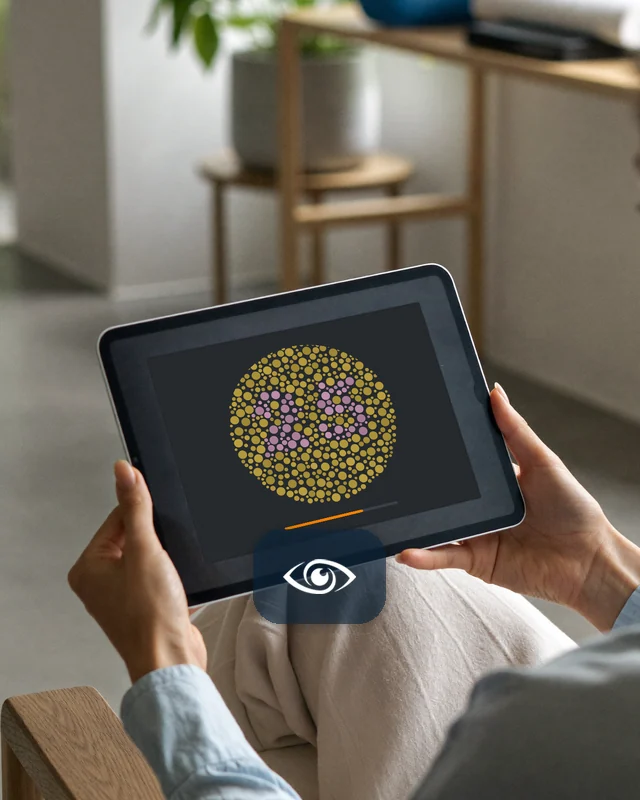
Online Colour Blindness Test
The colour blindness test screens red-green discrimination by asking you to read numbers hidden in pseudoisochromatic (Ishihara-type) plates made of coloured dots. People with a colour vision difference either cannot see the number or read it differently.
The plates fall into two groups: some are built on the protan line (red-sensitive cones), others on the deutan line (green-sensitive cones). Looking at which group is missed also gives an idea about the likely type. There is a numbers mode for adults and a shapes mode for children who cannot yet read.
The result is not a diagnosis. Screen type, brightness, night mode and ambient light can change colours. Congenital colour vision deficiencies remain stable for life; colour vision changes that begin later, however, may be an early sign of optic nerve or retinal disease and should always be shown to an ophthalmologist.
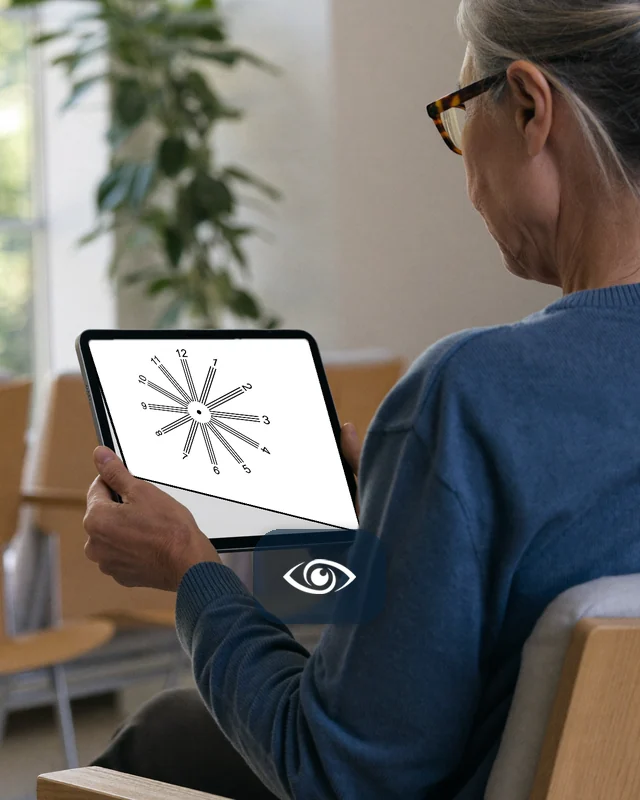
The astigmatism test asks you to look at a pattern of radial lines spreading out from the centre (a clock dial). Without astigmatism all lines look equally sharp and thick; with astigmatism the lines in one direction appear darker, thicker or sharper than the others.
The test assesses the right and left eye separately; at each stage you are asked to cover one eye and move about an arm’s length away from the screen. If you wear glasses or contact lenses you should keep them on, because what is being assessed is the difference that remains with your current correction.
Astigmatism occurs when the cornea or the lens of the eye is not perfectly spherical, so light cannot focus at a single point on the retina. It is very common and can be treated with a high success rate using glasses, contact lenses or modern laser methods such as SMILE Pro, LASIK and No-Touch PRK. A definite diagnosis requires an eye examination.
The treatment eligibility test is a short set of questions that performs a first screening for laser eye treatments and intraocular lens procedures. It asks about age, how much your prescription has changed in the past year, previous eye surgery and known eye conditions.
Eligibility cannot be decided from these questions alone; corneal thickness and topography, ocular surface health, pupil diameter and retinal assessment are measured with instruments. The test gives you a first idea of which method might be considered and clarifies the topics to discuss at the examination.
The smart lens simulation is not a test but a comparative visualisation. When you tick complaints such as near difficulty, distance blur, cataract and astigmatism, a slider lets you compare how the same scene looks with those complaints and how it is expected to look after treatment.
The aim is to set expectations correctly: trifocal and EDOF lenses greatly reduce the need for glasses at distance, intermediate and near, but do not give the same result in every eye. The actual outcome depends on corneal structure, pupil diameter and retinal health, so the simulation is a way of giving an idea, not a promise.
Performed at the right distance, with normal screen brightness and in a well-lit room, they give a useful first impression of vision and colour vision. Because they are unsupervised they do not replace a clinical examination; sharing the result with your ophthalmologist is recommended.
Can I take an eye test on a phone?
Yes, the tests also work on a phone. Set brightness to a normal level, turn off night mode and colour filters, and look straight at the screen. In the colour blindness test, screen settings are the factor that affects the result most.
Does the colour blindness test provide a diagnosis?
No. It only screens red-green discrimination and gives an idea about the likely type. A definite diagnosis requires colour vision tests and an examination performed by an ophthalmologist.
What should I do if my result is poor?
Do not panic; screen conditions can distort the result. Repeat the test in a well-lit room with night mode off. If the result is the same, or if you notice blurring, pain, flashes of light or a sudden change in your vision, consult an ophthalmologist without delay.
Important information. The tests on this page are for general information and preliminary screening only; they do not diagnose any condition and do not replace a comprehensive examination by an ophthalmologist. Results vary with screen type, calibration, distance, lighting and conditions of use. If you notice any change, blurring, pain or discomfort in your vision, please consult an ophthalmologist. These tools send no personal data to a server; all calculations run on your device.